Sunday, March 19, 2006

Patenting Thoughts

For example, the human genome exists in every one of us, and is therefore our shared heritage and an undoubted fact of nature. Nevertheless 20 percent of the genome is now privately owned. The gene for diabetes is owned, and its owner has something to say about any research you do, and what it will cost you. The entire genome of the hepatitis C virus is owned by a biotech company. Royalty costs now influence the direction of research in basic diseases, and often even the testing for diseases. Such barriers to medical testing and research are not in the public interest. Do you want to be told by your doctor, "Oh, nobody studies your disease any more because the owner of the gene/enzyme/correlation has made it too expensive to do research?"

Michael Crichton has an editorial, This Essay Breaks the Law in the New York Times (via Slashdot). It addresses a patent case before the US Supreme Court that will decide whether thoughts and relationships are patentable.
Friday, March 17, 2006

Who Can Name The Bigger Number?

Who Can Name The Bigger Number? (via Metafilter).

...

Ackermann numbers are pretty big, but they’re not yet big enough. The quest for still bigger numbers takes us back to the formalists. After Ackermann demonstrated that ‘primitive recursive’ isn’t what we mean by ‘computable,’ the question still stood: what do we mean by ‘computable’? In 1936, Alonzo Church and Alan Turing independently answered this question. While Church answered using a logical formalism called the lambda calculus, Turing answered using an idealized computing machine—the Turing machine—that, in essence, is equivalent to every Compaq, Dell, Macintosh, and Cray in the modern world. Turing’s paper describing his machine, "On Computable Numbers," is rightly celebrated as the founding document of computer science.

...

"Very nice," you say (or perhaps you say, "not nice at all"). "But what does all this have to do with big numbers?" Aha! The connection wasn’t published until May of 1962. Then, in the Bell System Technical Journal, nestled between pragmatically-minded papers on "Multiport Structures" and "Waveguide Pressure Seals," appeared the modestly titled "On Non-Computable Functions" by Tibor Rado. In this paper, Rado introduced the biggest numbers anyone had ever imagined.

...


I miss 365.

Big Dipper

The Astronomy Picture of the Day has a nice photograph of the Big Dipper today.

Thursday, March 16, 2006

White To Play And Win

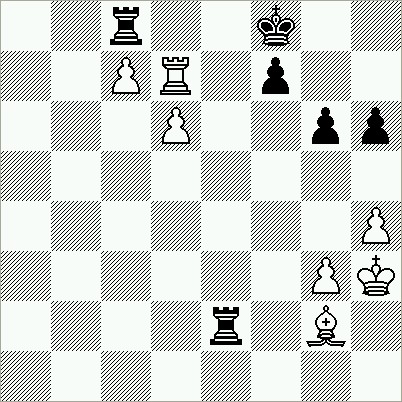
From my game today:


52. Rd8! Re8+
53. Rxc8 Rxc8
54. d7 Rxc7
55. d8=Q+ Kg7
59. Qxc7 +-

[In fact, 53. Rxe8+ is also winning since after both 53...Kxe8 54. Bc6+ Kf8 55. d7 and 53...Rxe8 54. d7 White wins the rook and promotes a pawn too].

Sunday, March 12, 2006

Banana Cake

Wednesday, March 08, 2006

Canada

Website aims to educate Americans about Canada [Globe & Mail]:

Oh sure, you hear about how everyone plays hockey in Canada, gets to the rink by dogsled and then goes home to an igloo.

But many myths about Canadians that circulate in the United States aren't nearly so silly or harmless.

...


For the record, I don't own a dogsled or igloo (and, in fact, have never used either). Similarly, I don't know Jimmy, Sally, or Suzy.

Hockey is practically a religion though.